Terms of Service Clauses Worth Reading
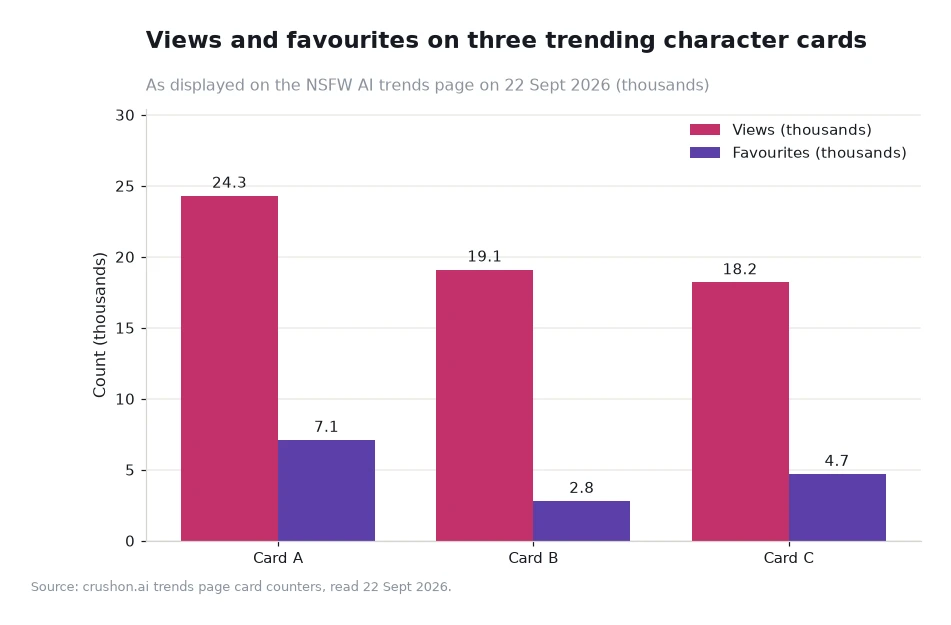
Most readers never open a terms page, and the clauses that actually shape an evening are the short ones: who the service is for, what the content is, and where to go when something is wrong. One number tells you why this matters — 4.7K favourites across 18.2M views works out at 2.6 savers per 10,000 readers, and every one of those readers agreed to the same terms.

Key takeaways
- Age and content clauses are the two that most directly describe the product you are using.
- Crushon publishes a compliance statement stating the content is AI-generated text and depicts no real person.
- The guidelines clause matters: an unfiltered service still states that limitations apply under its content and community guidelines.
- Reporting routes are worth finding before you need them — each content page is reportable, and there is a complaints process.
Start with the clauses that describe the product
The first category covers who may use the service and what the content is. That clause is usually published as a separate compliance statement, and on Crushon it carries a last-updated date of 8 February 2025 and states that the material is AI-generated text, that it depicts no real person, and that the service does not produce imagery or video of its characters. Read in plain language, that is an accurate description of a text product rather than a legal formality.
The second category is the community guidelines clause. This is the one readers most often skip because they assume an unfiltered platform means no rules. The platform's own FAQ says otherwise — some limitations apply in accordance with its content and community guidelines — and the honest reading is that "unfiltered" describes the content policy rather than the absence of one.
The clauses that give you a route
The third category is reporting and removal. A well-written clause here answers a practical question: what do I do when something is wrong? On Crushon, each content page can be reported directly, and there is also a published email route for content concerns, with the procedure set out under the content removal policy. That is the difference between a policy that exists on paper and one you can act on.
The fourth category is complaints. A separate complaints policy is unusual and useful, because it defines a path for problems that are not content problems — account issues, billing questions, or a report that was not handled as expected. Reading it once tells you what evidence a complaint needs and what response to expect.
| Clause category | Plain-language reading | Where to find it |
|---|---|---|
| Age and content statement | The service is for adults and the content is AI-generated text depicting no real person | The 2257 compliance statement |
| Community guidelines | Unfiltered is not unmoderated; some limitations apply | Site terms and the AI porn chat FAQ |
| Reporting and removal | Any content page can be reported, and there is an email route | The content removal policy |
| Complaints handling | A defined path for problems that are not about content | The complaints policy |
| Privacy and discretion | A private and secure environment with state-of-the-art encryption | The AI porn chat landing page |
It is also worth knowing what a clause cannot do. No terms page can make a service suitable for a reader it is not built for; the age and content statements define the audience precisely so that the rest of the document can be read in that context. Equally, a clause cannot substitute for the product description — if the two ever seem to part company, the clause is the one written to be relied on, and it is the one a support request will be answered against.
Worked example
Use the counters to see how thin the minority of returning readers is. Card A: 7.1K favourites from 24.3M views is 0.029%, or 2.9 favourites per 10,000 views. Card B: 2.8K from 19.1M is 0.015%, about 1.5 per 10,000. Card C: 4.7K from 18.2M is 0.026%, about 2.6 per 10,000.
Three cards, three rates — and in all three cases fewer than three readers in ten thousand chose to keep the card. That is not a criticism of the catalogue; it is a description of how casually most people browse. The reason to mention it in an article about terms is that the clauses above bind everyone in those large view counts equally. A reader who checks what the service is, what it will and will not do, and how to report a problem is in a small minority, and the checking takes about ten minutes.
Mind the difference between a policy and a promise, too. A policy documents behaviour and gives you somewhere to take a problem; a promise tells you what the service will never do. Adult services that publish the first kind tend to be more reliable than ones that publish the second, because the second cannot be verified by a reader. The test is simple: if a sentence would still be true after a serious failure, it was a promise, and it is worth treating as marketing rather than as a commitment.
How to read a terms page in ten minutes
Skip the section headings and search instead. Look for four words: eligibility or age, content, report, and complaint. Those four cover nearly everything that affects a reader's experience, and most terms pages answer each of them in a paragraph or two rather than a wall of text.
Then check the wording against the product. If a page promises absolute outcomes — permanent invisibility, content moderation that catches everything, or a service available without limits — you have found marketing rather than a policy, and the honest reading is that the clause is describing an intention. Crushon's own wording stays measurable: a private and secure environment, encryption described as a method, and a stated set of limitations under the guidelines. Wording that admits limits is more useful than wording that denies them.
Find the routes before you need them
Bookmark the two practical pages rather than the whole terms. The content removal policy explains how a report is made and what happens next, and the complaints policy covers everything that is not a content report. Having both to hand turns a frustrating evening into a form.
Then read the product description once, carefully. The ai porn chat page states the three things the service offers — customisable characters, a private and secure environment, and adaptive replies — and its FAQ answers what Porn Chat AI means without overclaiming. If a clause and a marketing page ever seem to disagree, treat the clause as the accurate one; that is what it is for.
Frequently asked questions
Does "unfiltered" mean anything goes?
No. The platform states that limitations apply under its content and community guidelines, so the term describes the content policy rather than the absence of rules.
How do I report a page I think is wrong?
Each content page can be reported, and the content removal policy sets out an email route as well. The procedure is documented rather than discretionary.
Is there a route for problems that are not about content?
Yes. A separate complaints policy covers account and service issues, which is worth knowing before an issue arises rather than afterwards.
Ten minutes, four words
Search a terms page for eligibility, content, report and complaint, then read the product description for anything a clause seems to contradict. That routine is short enough to run before you commit and complete enough to answer the questions that actually come up.
Sources read on 22 Sept 2026: the platform's compliance statement[1], content removal and complaints policies, and the trends page counters used for the keep rates. Every page named above was read 22 Sept 2026. For readers aged 18 and over.